Richard Feynman's sum-over-histories formulation invites a disorienting thought. To calculate what happens between the preparation of a quantum system and its detection, we account for contributions associated with many possible paths. A marble would simply follow one road. The mathematics of a quantum particle refuses to be so easily narrated.
But I want to ask a question prior to the calculation. What if the particle does not have to travel everywhere because what it is made of is already everywhere? What if the particle is not a little independent traveler, but a localized configuration of a more extensive reality?
The path integral does not prove that this is true. Nor does it imply that a particle literally races to the Moon and back faster than light. It gives a method of calculating amplitudes. My question is ontological: what kind of thing could the mathematics be describing?
Feynman's mirror: the question that started it
Before imagining higher dimensions, look at the actual mirror example. Its many thin routes are the visual key to the sum-over-histories idea.
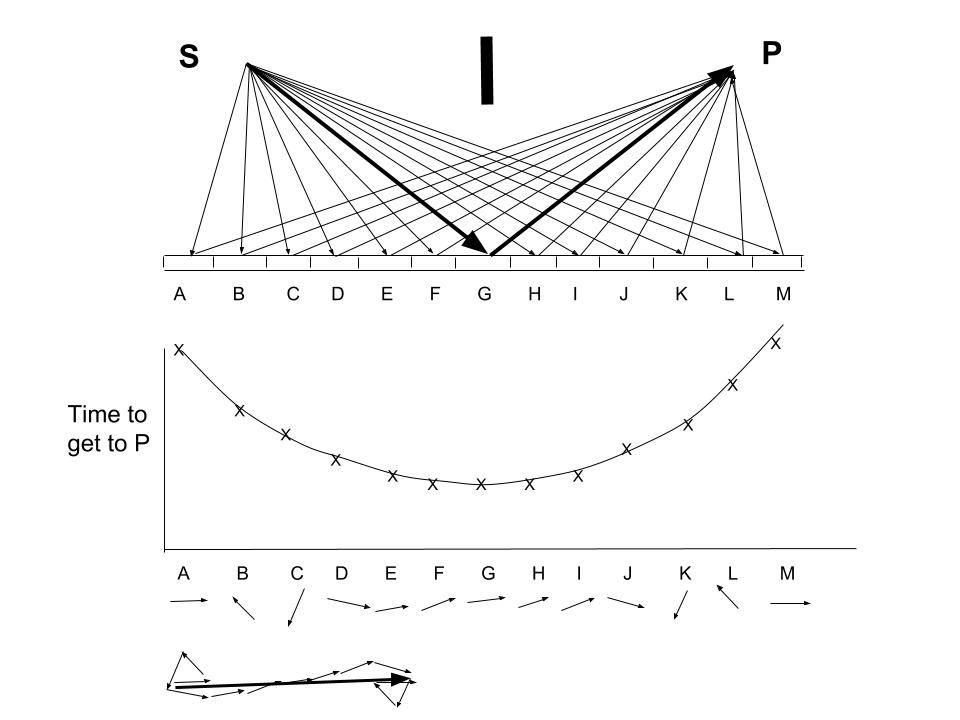
There is an important step in the argument: adding different paths is what produces a probability amplitude. The resulting interference does not imply the particle's substance must literally occupy every point. That remains the philosophical possibility I want to examine.

1. The moving dot that never moved
Imagine a bright white dot crossing a television screen. We point and say, “There it goes.” Yet no tiny white substance travels across the glass. One group of pixels lights up, then another. The whole screen is already present. The moving dot is a sequence of localized expressions of the same underlying display.
Suppose you knew only the picture, never the screen. You might construct perfect equations for the dot's speed and trajectory. You might speak of the dot as an object, with a location and a history. Your equations could be correct while your picture of what exists was incomplete.
I am not proposing that nature has pixels or a programmer. The screen is an analogy for the possibility that what we call an object is a pattern rather than an independently transported substance.

2. The wave that travels without taking its water
Stand beside a pond. A crest moves toward the shore. The crest is real: it carries energy, bends around obstacles, interferes with other waves. Yet the water does not simply travel from the center of the pond to the shore along with the crest. Its local motion sustains the moving form.
Return to the television dot. On the screen, different pixels participate in the same apparent motion. On the pond, different portions of water participate in the same moving crest. In both cases, a local manifestation has a trajectory while its supporting reality is distributed.
Could an electron be more like the crest than the marble? That would not make the electron a classical water wave. Quantum interference, discrete detections, and spin require much more than a fluid analogy. But it changes the first question: perhaps we should ask what maintains the form before asking which road the form took.

3. The traffic jam that moves backward
On a highway, a traffic jam can propagate backward while every participating car moves forward. The jam is not any one car. It persists through a succession of cars slowing down and accelerating. Its identity lies in a relation among local events.
Compare it with the screen's dot and the pond's crest. All three can be assigned a location and speed. All three are coherent phenomena. Yet their apparent motion is not the motion of a permanently self-identical lump of material.
Perhaps this is one way to think about a particle's history: not the itinerary of a microscopic bead, but the persistence of an organized relation in a larger medium. The analogy does not license instantaneous influence. Traffic disturbances and water waves have finite propagation speeds; an underlying universal structure would likewise need dynamical rules consistent with relativistic causality.
4. The knot that is made of nothing but rope
Tie a knot in a rope. It can be tightened, shifted, or brought close to another knot. You do not have to add a foreign substance to make the knot. The knot is a stable organization of what was already there.
Here the analogy moves beyond motion toward particle identity. The screen's dot may vanish when the pixels turn off. A pond's crest may disperse. A traffic jam may dissolve when drivers accelerate. A knot can persist because its geometry constrains how it can change.
Imagine a higher-dimensional medium whose localized structures close upon themselves, like packets. They might have boundaries, internal circulation, pressure-like interactions, and topological properties. A particle would be the packet, not an object trapped inside it. Its mass might reflect the energy needed to sustain the configuration. Different stable forms might correspond to different kinds of matter.
This is where metaphor reaches its limit. Electron spin is not ordinary rotation of a tiny ball; its half-integer transformation properties are precise. Charge is not merely the direction of a whirlpool. Matter and antimatter cannot be derived just by reversing the flow. Those possibilities are questions for mathematics, not achievements of the analogy.

5. The universe as both the screen and the picture
Seeing fewer dimensions than the object has
Take a glass of water into the sunlight and look at the bright curves on the table. The table receives a two-dimensional pattern from light passing through a three-dimensional object. It does not contain a little glass inside the shadow. The picture is an outcome of the glass, the light and their geometry.


Now carry the same thought up one dimension: a four-dimensional mathematical object can be represented by a changing three-dimensional projection. We cannot put a physical four-dimensional cube on the table, but we can compute its projections. The animation below is a mathematical demonstration, not an image captured from a real extra dimension.

My philosophical question: might a stable structure in a deeper reality become visible to us only through a localized lower-dimensional pattern? The images teach what a projection means. They do not establish that electrons actually are such projections.
The deepest version of the proposal is not that particles float inside an invisible material. It is that the medium, the particles, the apparent space between them, and perhaps the geometry of spacetime itself are different descriptions of one underlying structure. Call it U—not as an answer, but as a name for the unknown.
We can now revisit the same four examples. The screen gives a distinction between the display and its image. The pond gives a distinction between a medium and its propagating forms. The traffic jam shows that an entity can be a coherent pattern among many local events. The knot suggests how a configuration might persist because of its organization. None of these is a complete model of U. Together they help articulate a possibility that our usual noun “particle” may conceal.
Perhaps the extra dimensions of U are literal spatial directions. Perhaps they are internal degrees of freedom, or a configuration space that cannot be pictured as another floor above our universe. A fifth coordinate labeling alternative histories is not automatically a fifth spatial direction. The number and nature of dimensions must come from the theory rather than the illustration.
6. What forces might mean

Imagine two knots on the same rope. Their motions can change the tension between them. Two waves in the same pond interfere and, in a nonlinear medium, affect one another. Traffic jams interact through the behavior of the same drivers and roads. Two bright dots on a screen may share a circuit even when they look separate.
These images invite a common-origin explanation of interactions. If particles are localized organizations of U, perhaps their apparent forces express how U responds to their combined state. But calling one deformation gravity and another electromagnetism does not derive either. Gravity must reproduce spacetime curvature and relativistic tests. Electromagnetism must produce its gauge structure and precise charge law. Strong and weak interactions require color, chirality, confinement, and specific particle representations.
The Higgs raises another question: might the emergence or closure of a packet involve a collective mode that changes the energy cost of other configurations? Perhaps. Yet the observed Higgs is a specific electroweak field with measured couplings. A resemblance to a collapsing surface is not a derivation.
7. Why our own bodies make this less alien

My body has a recognizable identity, but its constituents and internal processes change. A melody remains recognizable when played by another instrument. An institution persists while its members change. The traffic jam remains while the cars passing through it change. The wave travels without transporting all its water. The screen image survives while its illuminated pixels change. The knot remains an organization of the rope.
These everyday experiences show that persistence is not always a matter of keeping the same material inventory. It may be a matter of maintaining structure through change. At the scale of elementary particles the analogy becomes more demanding, not less: every electron has the same fundamental properties to astonishing precision. An underlying theory must explain that exactness, not merely celebrate pattern and process.
8. Already everywhere is not the same as detectable everywhere

If U is present throughout the universe, it does not follow that one observed electron is a classical object simultaneously occupying every place. A pond fills its basin, yet a crest can be localized. The television screen exists across its surface, yet only one dot may be bright. The road extends for miles, yet congestion has a definite region. A rope extends beyond a knot, yet the knot is located somewhere.
The idea therefore requires a distinction between the extent of the underlying structure and the localization of a measurable event. That distinction must explain why detectors click in particular places, why interference disappears under decoherence, and why correlations do not allow signals to travel into the past.
Feynman's path integral becomes a challenge for this ontology, not its evidence. If U is the primary reality, can the interference rules of quantum mechanics be derived from U's dynamics? Can one recover the experimentally successful mathematics without assuming the answer in advance?
9. The cost of turning a metaphor into a theory

One would have to specify the degrees of freedom of U, write an action, derive stable closed packets, recover fermionic spin and statistics, generate the correct charges and interactions, and predict quantities not chosen as inputs. A packet with the wrong electron mass would not be saved by poetic language. Nor would a mathematical contradiction be repaired by calling it a deeper dimension.
That is why the philosophical question is worth separating from the formal papers. Philosophy can ask what we have taken for granted. Physics must decide which answers survive.
Perhaps the particle does not have to visit everywhere. Perhaps what allows it to appear here was never confined to here in the first place.
The point is not to claim that Feynman secretly proved this. The point is to begin where his mathematics leaves an ontological question open—and then accept the discipline required to answer it.